Why Automated Job Ads Outperform Manually Managed Recruitment Campaigns

Your best candidates aren't browsing job boards. They're scrolling Instagram during their commute, checking Facebook between meetings, and discovering opportunities where they already spend their time.
Manual recruitment campaigns can't keep pace with where talent lives today.
By the time you've crafted ad copy, set budgets, and launched across channels, your competition has already captured attention with automated campaigns running 24/7 across paid social.
Recruitment automation transforms how companies attract talent by streamlining paid job advertising across the channels next-gen candidates actually use.
Let’s dig deep and find out how automated job ads outperform manually managed hiring campaigns!
When Manual Campaign Management Falls Behind
Manual job advertising worked when hiring relied on a few job boards and limited competition.
Today, talent attraction requires paid distribution across multiple platforms, frequent creative updates, and constant budget decisions.
Markets move faster than teams can respond. Performance shifts daily based on competition, algorithms, and candidate behaviour. When campaigns are reviewed weekly, wasted spend and missed opportunities are unavoidable.
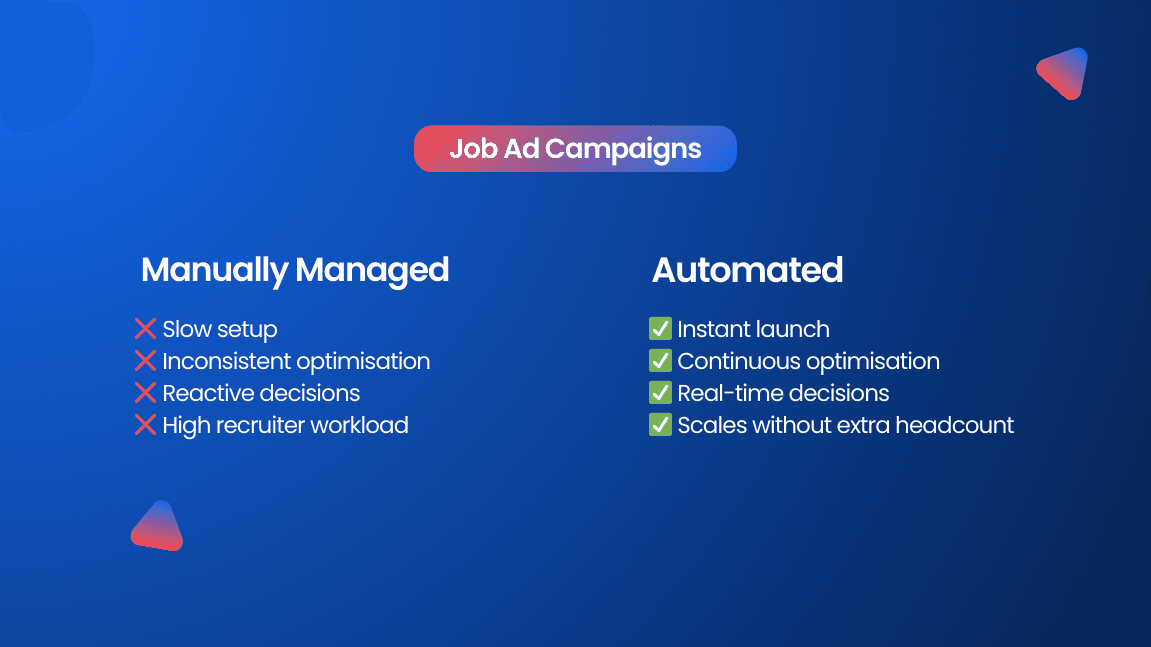
Manual execution breaks down in three key ways:
Underperforming ads continue running while high-performing ones are not scaled fast enough.
Campaign quality varies by who set it up. Best practices are not applied consistently or retained over time.
Increasing hiring volume requires more people just to maintain current performance. Quality declines as teams become overloaded.
Automation removes these constraints by standardising execution and responding to performance in real time.
Speed and Always-On Presence Matter
Automation operates at speeds impossible for human teams.
For instance, when a job gets posted to your ATS, an automated system can have ads live across multiple platforms within minutes.
In contrast, manual processes require someone to notice the new job, create campaigns, write ad copy, set targeting parameters, establish budgets, and launch across channels.
That typically takes hours or even days.
Time to market determines your candidate pool quality. The best candidates are available briefly. They apply to early opportunities and accept offers quickly.
As a result, fast campaigns fundamentally improve the quality of candidates you reach.
Consider a logistics company hiring 200 warehouse workers monthly. Manual campaign management means constant firefighting, rushed launches, and inconsistent candidate flow.
However, automated systems maintain steady pipeline flow regardless of when jobs open, when candidates browse social media, or when your recruitment team is working.
Continuous Optimization vs. Occasional Adjustments
The most significant performance advantage automated job ads hold over manual campaigns comes from continuous optimization.
Automated systems test, learn, and adjust constantly based on real performance data.
On the other hand, your manual optimization happens episodically when someone has time to review campaigns and make changes.
Machine learning identifies patterns you miss. For instance, automated platforms analyze thousands of variables simultaneously. They spot correlations between performance and factors like time of day, device type, audience demographics, creative elements, and platform dynamics.
Budget Efficiency Through Real-Time Adjustment
Every dollar wasted on recruitment advertising is a dollar that could have hired another candidate.
Therefore, budget efficiency directly impacts how many quality hires your talent acquisition spending produces.
Automated systems optimize budget allocation continuously while manual management allows significant waste. For instance, connected to your ATS, automated hiring tools pause advertising within minutes of a job being filled.
Manual processes often mean ads continue running for hours or even days after a position is filled because no one has paused the campaign yet.
Data Quality That Drives Better Decisions
Manual campaign management introduces data quality problems that undermine your decision making.
Common data quality issues with manual processes:
Someone forgets to enable tracking on a campaign
Conversion codes get implemented inconsistently
Attribution becomes guesswork when candidates interact with multiple touchpoints
Performance reports are only as current as the last time someone manually compiled data
In contrast, automated systems maintain consistent tracking across everything. Every campaign launches with proper tracking in place. Every interaction is logged. Every conversion is attributed.
As a result, the data collection happens automatically without requiring human attention, which means it's comprehensive and consistent across all campaigns, platforms, and time periods.
Real-time dashboards surface insights immediately. Your manual reporting means waiting for someone to pull data, build reports, and distribute them to stakeholders. By the time leaders see the information, therefore, it's already outdated.
Automated systems also track the entire candidate journey, providing accurate multi-touch attribution that shows what actually influences applications and hires.
You stop overinvesting in channels that get credit for conversions they didn't actually drive and start properly funding the touchpoints that genuinely influence candidate decisions.
Consistency as You Scale
Companies hiring at scale manage dozens or hundreds of concurrent campaigns across multiple locations, roles, and platforms.
Manual management of this complexity introduces errors, inconsistencies, and performance variability that directly impact your results.
Automated systems apply best practices uniformly. Once you've configured optimal settings, targeting parameters, creative guidelines, and budget rules, automated systems apply them consistently across all campaigns.
Consequently, there's no variance based on who set up a particular job or how busy they were that day. Every campaign benefits from organizational knowledge and proven strategies.
Scaling doesn't degrade quality with automation. Manual processes degrade as volume increases because people get overwhelmed, cut corners, and make mistakes under pressure.
Better Candidate Experience Through Automation
Another advantage of automated systems is that they deliver better candidate experiences because they enable personalization at scale and ensure consistent, high-quality interactions.
In fact, the assumption that automation makes experiences less personal is backwards in recruitment advertising.
Personalized ad creative increases relevance:
Manual campaign management typically means creating one ad per job and showing it to everyone. In contrast, automated systems with dynamic creative optimization can show different ad variations to different candidate segments
Faster responses meet candidate expectations. When candidates click your ad, they expect a streamlined application experience and timely follow-up.
Consequently, automated systems that integrate with your ATS can trigger immediate confirmation emails, schedule interviews automatically, and keep candidates informed throughout the process.
The ROI Case You Can Take to Leadership
The business case for automated job advertising becomes clear when you analyze total costs and returns.
While automated platforms require technology investment, the combination of improved performance and reduced labor costs delivers rapid ROI.
Technology costs are offset by budget efficiency gains. A typical automated job advertising platform might cost $2,000 to $5,000 monthly depending on your hiring volume.
Meanwhile, the 25% budget waste elimination and 30% to 40% improvement in cost per hire that automation delivers saves far more than the platform costs, even for mid-sized hiring operations.
Every day a position remains open costs you money in lost productivity, delayed projects, or overtime for existing staff covering the gap.
Therefore, automated job advertising that launches instantly, optimizes continuously, and delivers candidates faster can reduce your time to fill by 25% to 40%.
For roles with high business impact, vacancy cost reduction often exceeds all other savings combined.
The Competitive Reality You're Facing
Companies competing for the same talent pool are making strategic choices about how they attract candidates.
Those using automated job advertising reach candidates faster, engage them more effectively, present more relevant opportunities, and convert at higher rates.
If you're still relying on manual campaign management, you're outgunned.
Market leaders have already transitioned. Enterprise organizations and recruitment technology companies moved to automated job advertising years ago. The competitive advantage they gained is significant and growing.
Meanwhile, mid-sized companies and traditional employers that maintain manual processes face systematic disadvantages in talent competition against organizations using superior technology.
Candidate expectations reflect modern standards. Job seekers interact with sophisticated, personalized, automated marketing across every other aspect of their digital lives.
Therefore, when they encounter clunky, slow, generic job advertising from your organization, they notice. The experience signals that you lack modern capabilities or don't value candidates enough to invest in quality interactions.
Automated vs Programmatic Recruitment: Understanding the Difference
The terms "automated" and "programmatic" are often used interchangeably in recruitment marketing, but they represent different approaches with distinct advantages.
Automated recruitment advertising focuses on streamlining campaign execution and optimization. It removes manual tasks like ad creation, budget allocation, and performance monitoring.
Programmatic recruitment advertising takes automation further by adding real-time bidding and audience targeting across ad exchanges. Programmatic platforms bid on ad inventory in milliseconds, placing your job ads in front of the right candidates at the optimal moment across thousands of websites and apps.
It's the same technology that powers modern digital advertising at scale.
The key differences:
Scope and scale: Automated systems focus on platforms like Facebook, Instagram, and LinkedIn, while programmatic extends reach across display networks, video, mobile apps, and premium sites.
Targeting precision: Automation uses platform-native tools; programmatic leverages third-party data and cross-platform signals to find candidates wherever they browse.
Bidding strategy: Automated systems optimize bids within each platform. Programmatic uses real-time bidding across multiple exchanges for cost-efficient reach.
Creative distribution: Automation deploys ads to specific channels. Programmatic dynamically places ads where your audience is most engaged.
Transform Your Talent Attraction with Programmatic Recruitment
Manual recruitment campaigns made sense when hiring was simpler and competition was limited.
Today's talent market demands a different approach, one that meets next-gen candidates where they spend their time and delivers experiences they expect.
Wonderkind is built specifically for modern talent attraction:
Automated paid job advertising that launches within minutes of jobs opening in your ATS. No manual campaign setup. No delayed launches. Your ads reach candidates while they're still available.
Multi-channel distribution across Facebook, Instagram, LinkedIn, Google, TikTok, and programmatic display networks. One platform manages your entire paid job advertising strategy.
AI-powered creative optimization that generates visual, mobile-first ads and continuously tests variations to identify top performers. Your ads stay fresh and engaging without constant manual updates.
One-click application experiences using Meta Lead Form Ads and mobile-optimized landing pages. Candidates apply in seconds without friction, dramatically improving conversion rates.
Real-time budget optimization that shifts spend to your best-performing channels and pauses campaigns immediately when positions fill. Every dollar works harder.
Comprehensive analytics with multi-touch attribution showing exactly which channels and touchpoints drive applications and hires. You make budget decisions based on actual performance data, not guesswork.
Seamless ATS integration that connects directly to your existing recruitment infrastructure. Jobs flow out automatically. Candidate data flows back in. No manual data transfer.
Related articles
Never miss a post
Ready to write your own results?
Tell us what you need to hire and we'll show you what Wonderkind can do for your roles.
No credit card required