10 Recruitment Trends to Watch Out For in 2026

The recruitment landscape is shifting faster than most hiring leaders realize. What worked in 2024 feels outdated by mid-2025, and by 2026, the gap between traditional and modern talent attraction will be impossible to ignore.
Companies still relying on post-and-pray methods will find themselves competing for the same shrinking pool of active job seekers, while forward-thinking organizations build pipelines filled with quality candidates who never visit a job board.
The trends outlined here are not emerging; they're accelerating. Budget scrutiny is tightening. Candidate expectations are rising.
Hiring volumes remain high while talent availability stays low. Leaders who adapt now will own 2026. Those who wait will spend the year explaining why their cost per hire keeps climbing while application quality declines.
Let's examine the ten recruitment trends that will define hiring in 2026, why each one matters, and what they mean for talent acquisition and marketing leaders managing performance, scale, and ROI.
Hiring Moves From Search-Based to Discovery-Based
Candidates no longer actively search for jobs as their first step. They discover opportunities while scrolling social platforms, consuming content, and engaging with brands they didn't know were hiring.
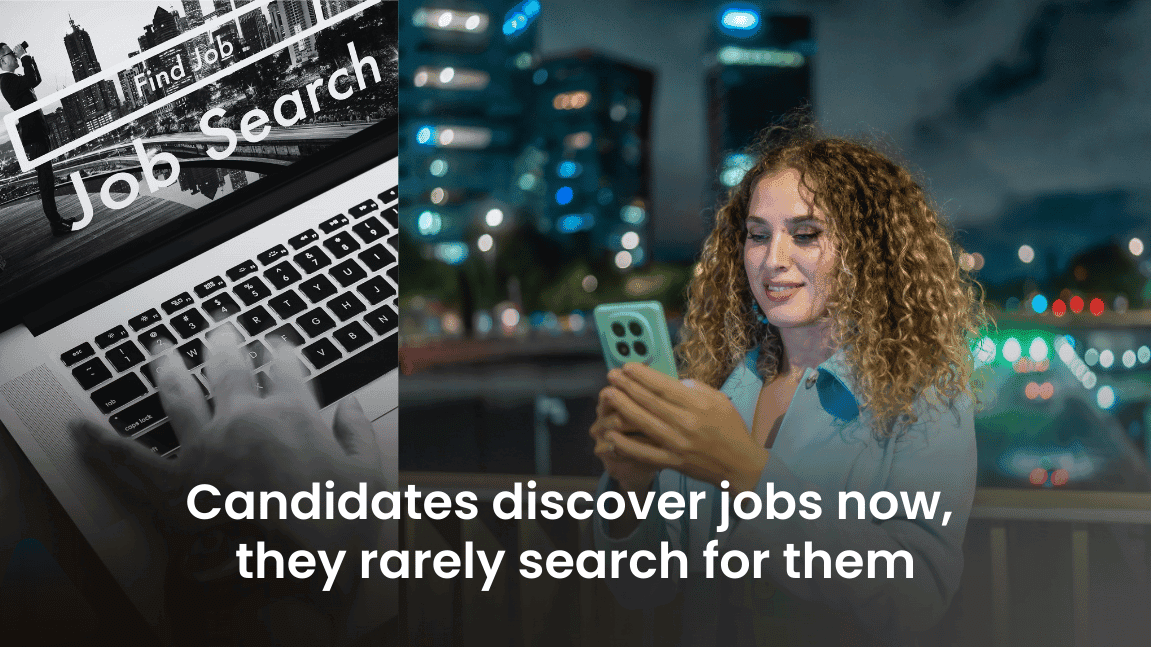
The majority of global workforce consists of passive talent not actively job searching, yet they remain open to the right opportunity presented at the right moment.
Social media has become the primary discovery environment where candidates encounter job content the same way they discover products or entertainment.
Why this accelerates:
Next-gen talent spends significantly less time on job boards and more time in feeds
Job boards require intent; social feeds require only presence
Platforms like TikTok, Instagram, and LinkedIn optimize for passive consumption
Algorithms serve content based on behavior, interests, and demographics
Impact for leaders:
Hiring becomes proactive rather than reactive
Reach expands dramatically beyond active job seekers to passive talent
Access to currently employed candidates open to better opportunities
Time to hire shortens through immediate discovery and action
A nurse scrolling Instagram sees a hospital offering better shift flexibility. She applies that evening. No job board visit. No lengthy search process. Just discovery, interest, and action.
Recruitment Marketing Becomes Accountable Performance Marketing
The days of reporting impressions and clicks as success metrics are ending. Recruitment marketing is being held to the same standards as demand generation and customer acquisition.
Budget pressure increases as organizations face scrutiny.
When recruitment budgets are substantial and hiring represents one of the largest investments any company makes, leadership demands clarity on ROI.
Key shifts:
Cost per hire replaces cost per click as the meaningful metric
Quality applications matter more than raw volume
Marketing and hiring KPIs align with shared language around conversion rates and funnel efficiency
Teams need members who understand both talent acquisition and digital marketing
What this requires:
Recruitment platforms providing granular performance data
Stakeholder communications highlighting business outcomes rather than recruiting activity
Continuous optimization and budget allocation to highest-performing channels
Transparent, outcome-focused reporting
Creative Quality Becomes the Main Differentiator
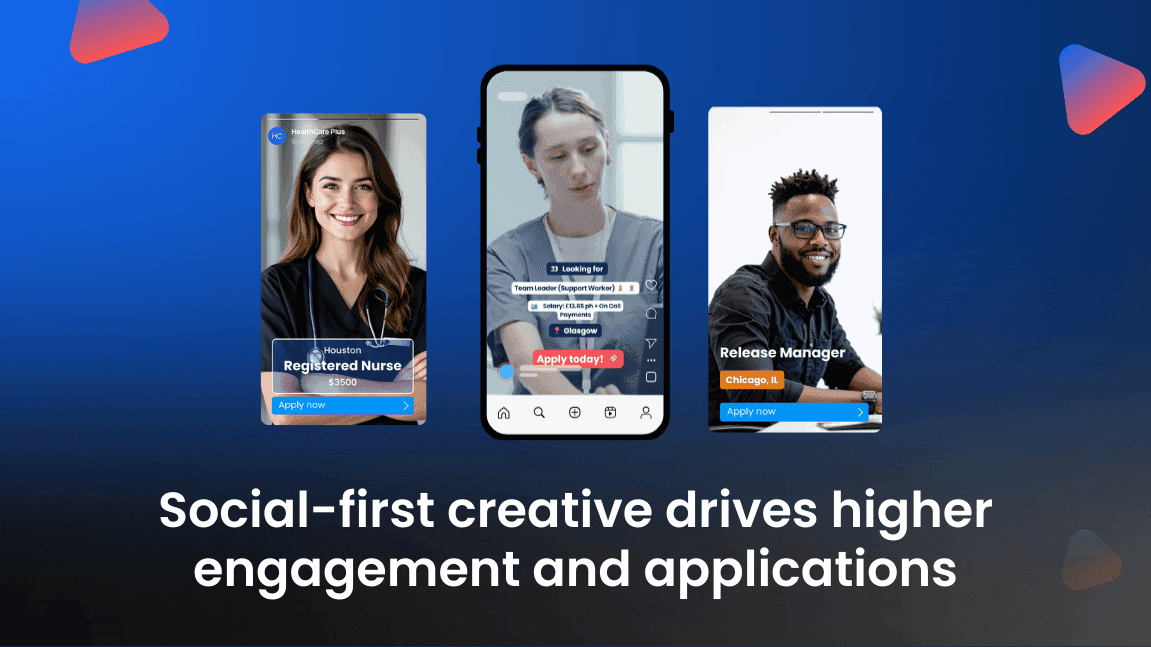
Generic text ads stop converting. Candidates scroll past bland, corporate job postings without a second glance. Creative relevance determines whether someone pays attention and takes action.
Job ads compete for attention against entertainment, news, and social content designed by professional creators.
Why quality matters now:
Average attention spans continue shortening
Candidates evaluate hundreds of pieces of content daily
Job ads must meet the same production standards as other feed content
Next-gen candidates expect visual storytelling and authentic representation
Decisions happen within seconds
What leaders need:
Employer branding and performance converging into a single function
Continuous creative testing rather than occasional updates
Systems for rapid creative production and testing at scale
Dynamic content adapting to viewer demographics, interests, and behaviors
Video, carousel ads, and interactive formats
Recruitment Automation Replaces Manual Campaign Work
Manual setup, monitoring, and optimization no longer scale effectively.
Automation technology has matured to where machines handle routine optimization better than humans. Algorithms analyze performance data continuously, make real-time adjustments, and learn from outcomes faster than any manual process.
Why automation wins:
Hiring volumes fluctuate unpredictably while teams stay lean
Organizations can't afford large recruitment marketing teams
Manual processes can't flex to meet variable demands
Real-time optimization drives better performance
Impact for leaders:
Always-on campaigns run without constant oversight
Jobs automatically promoted when open, paused when filled
Small teams manage large-scale hiring with enterprise sophistication
Professionals focus on strategy rather than campaign mechanics
Budget efficiency increases as automation eliminates wasted spend
Candidate Experience Drives Conversion Directly
Candidate experience is no longer a nice-to-have soft initiative. It directly impacts conversion rates, application completion, and hiring outcomes.

Every friction point creates drop-off. Every positive interaction increases the likelihood someone applies and accepts an offer.
Why experience matters more:
Social media amplifies negative experiences quickly
Review sites make candidate experience public and permanent
Candidates expect mobile-friendly applications, clear communication, and respectful treatment
Poor experiences damage employer reputation in ways that ripple beyond individual candidates
Measurable benefits:
Higher application completion rates translate to larger talent pools
Doubling completion rates from 30% to 60% doubles your pipeline without additional spend
Better candidate quality follows positive experiences
Good experiences lead to referrals, positive reviews, and repeat applications
Employer brand becomes an asset rather than liability
Social Platforms Outperform Traditional Job Boards
Social channels become the primary source of quality applications for high-volume roles.
Job boards have a place for specialized positions and active seekers, but for organizations hiring dozens or hundreds monthly, social platforms deliver superior reach, targeting, and results.
Why social wins:
Billions of active users spending hours daily on platforms
Audience exponentially larger than job board traffic
Sophisticated targeting based on location, skills, interests, behaviors, demographics
Creative flexibility enabling visual, engaging content
Video, carousel ads, stories, and interactive formats outperform text listings
Platforms optimize for engagement and conversion
Benefits for leaders:
Reduced dependency on job boards decreases costs
Diversified talent sources reduce vulnerability to pricing increases
Broader and more diverse pipelines from massive reach and precise targeting
Real-time data, clear attribution, and granular performance metrics
Connection with candidates who never visit job boards
Programmatic Advertising Becomes Standard Practice
Programmatic job advertising moves from emerging technology to standard practice.
Automated buying and selling of job ad placements across multiple channels based on real-time bidding transforms how organizations distribute recruitment marketing spend.
Instead of manually placing ads on individual sites, programmatic platforms automatically find the best placements for the lowest cost.
Why programmatic matters:
Candidates expect personalization similar to consumer advertising
One-size-fits-all job ads no longer work
Budget efficiency pressures force maximizing every dollar
Technology handles complexity impossible to manage manually
Programmatic capabilities:
Retargeting candidates who visited career sites but didn't apply
Excluding current employees from job ads
Dynamically adjusting bids based on performance by source, location, or role type
Showing the right ad to the right person at the right time
Results:
Higher engagement rates
Improved candidate match quality through precise targeting
Lower cost per application and cost per hire
Maintained or increased volume and quality
Data-Driven Personalization Becomes Table Stakes
Generic messages to broad audiences produce declining results. Candidates expect job advertising to be as relevant as product recommendations, news articles, and entertainment content they receive across other digital experiences.
Technology now enables dynamic job ads automatically adapting to viewer demographics, interests, and candidate journey stage.
The same role can be presented differently to a recent graduate versus an experienced professional, to someone in a different city, or to someone who previously visited your career site.
Why personalization accelerates:
Candidates conditioned by years of personalized experiences across e-commerce, streaming, social media, and search
Generic recruitment messaging feels lazy and impersonal
Tools for personalization have become accessible and affordable
Barrier to entry dropped while competitive necessity rose
Benefits:
Personalized content performs significantly better across every metric
Improved candidate match quality
More efficient ad spend from better performance per impression
Better candidate experiences and stronger connections
HR and Marketing Converge Around One Hiring Funnel
Hiring stops living in silos separated by department, budget, and strategy. Talent attraction requires marketing expertise and principles.
Companies increasingly structure recruitment marketing as a collaborative function with shared ownership, metrics, and accountability.
Recruiting and marketing solve similar challenges: creating awareness, building interest, driving action, and measuring performance. The tactics differ, but the strategic approach is identical.
Why convergence happens:
Talent shortages turn hiring into growth constraints
Companies that can't fill roles can't execute business plans
Leadership recognizes talent acquisition as a business challenge requiring full organizational attention
CFOs and CEOs demand the same rigor applied to customer acquisition
Impact:
Shared metrics and accountability align incentives
Marketing and HR track same conversion rates, cost metrics, quality indicators
Better internal alignment speeds decision-making
Clearer authority and better communication streamline approvals
Campaign launches accelerate and optimization happens continuously
High-Volume Hiring Demands Always-On Strategies
Campaign-based hiring becomes insufficient for ongoing needs in industries with continuous turnover and consistent hiring demands.
Healthcare, logistics, retail, manufacturing, and hospitality require constant inflow of quality candidates to maintain operations and support growth.
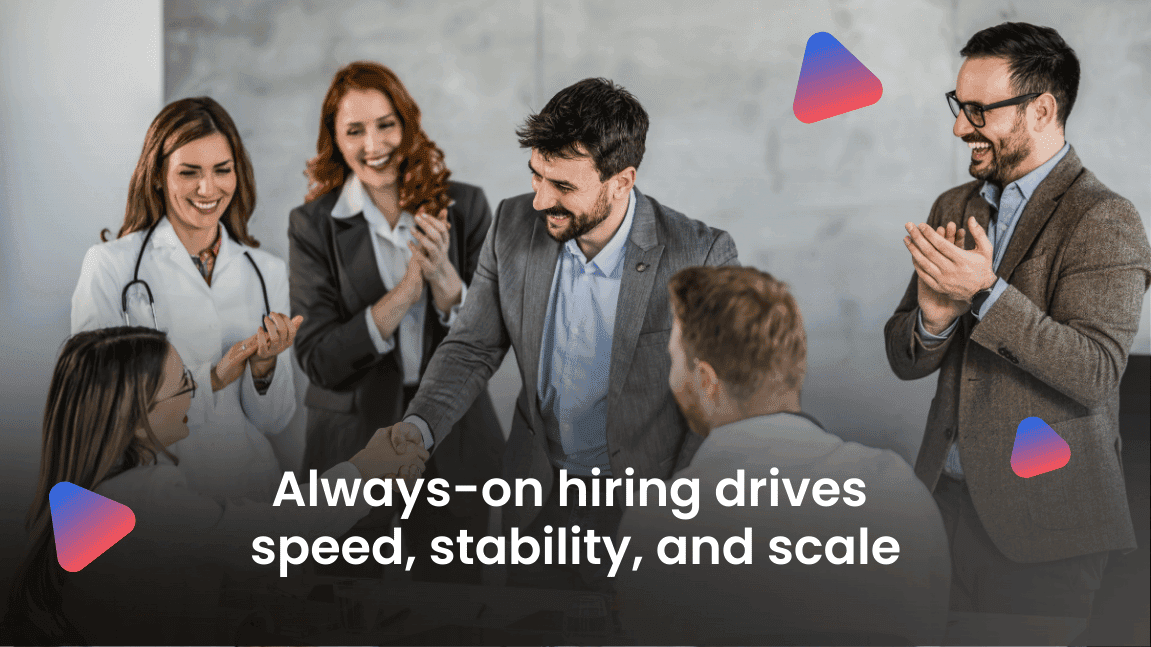
Always-on strategies maintain continuous presence in front of target candidates, keep pipelines full, and enable quick fulfillment when roles open.
Why always-on matters:
Turnover remains elevated while talent scarcity persists
Stopping and starting campaigns creates operational gaps
Companies with full pipelines fill roles in days
Those starting from scratch take weeks or months
Speed to hire determines customer service quality and operational capacity
Benefits for leaders:
Predictable pipelines eliminate rushed hiring chaos
Clear visibility into candidate flow enables accurate forecasting
Better candidate experience and more thoughtful selection
Improved quality of hire from measured choices rather than pressured decisions
Strategic workforce planning rather than reactive staffing
Proactive team building and confident growth support
Related: Best Recruitment Advertising Campaigns of 2025 (and What You Can Learn From Them)
Preparing for 2026
These trends aren't predictions, they're accelerations of changes already underway.
Organizations that thrive will recognize these shifts early and adapt talent attraction strategies accordingly.
Audit your current approach:
Are you discovery-based or search-based?
Do you measure recruitment marketing like other marketing investments?
Is your creativity excellent or adequate?
Have you automated what can be automated?
Does candidate experience drive conversion or create friction?
Are you leveraging social platforms and programmatic capabilities?
Have you implemented personalization?
Do HR and marketing work as partners?
Have you built always-on strategies for high-volume needs?
The gaps you identify represent opportunities. Closing them requires investment, change management, and new capabilities. But the cost of inaction is higher.
Companies stuck in traditional approaches will watch cost per hire climb, quality decline, and time to fill extend while competitors using modern strategies fill pipelines efficiently and affordably.
The future of talent attraction is automated, performance-driven, candidate-centric, and social-first.
The question isn't whether these trends will define 2026, but whether your organization will lead or follow.
Ready to transform your talent attraction strategy for 2026?
Wonderkind's AI-powered platform automates job advertising across social channels, optimizes campaigns continuously, and delivers quality candidates at industry-leading ROI.
Book a demo to see how next-gen hiring technology can future-proof your recruitment strategy.
Related articles
Never miss a post
Ready to write your own results?
Tell us what you need to hire and we'll show you what Wonderkind can do for your roles.
No credit card required